
Every parent wants their child to grow up healthy, intelligent, creative, and confident. Childhood is an important period for brain development because children learn new skills, explore their surroundings, develop language abilities, and build social relationships through everyday experiences.
One of the best ways to support this development is by introducing enjoyable learning opportunities at home and outdoors. The right Fun Activities can help children improve memory, concentration, creativity, problem-solving abilities, communication, and emotional development.
You do not need expensive toys, complicated equipment, or special learning programs to support your child’s brain development. Simple activities such as reading stories, solving puzzles, playing building games, drawing, and exploring nature can provide valuable learning experiences.
In this guide, we will explore 15 fun activities to improve your child’s brain development and help parents make everyday learning more exciting.
Why Are Fun Activities Important for Child Brain Development?
Children learn through playing, observing, experimenting, and interacting with other people. Play-based experiences give children opportunities to practice important thinking and social skills in an enjoyable environment.
Different activities support different areas of development, including:
- Memory: Remembering instructions, patterns, stories, and information.
- Concentration: Paying attention to tasks and completing activities.
- Creativity: Exploring new ideas and expressing imagination.
- Problem-solving: Finding solutions to everyday challenges.
- Language: Developing vocabulary and communication skills.
- Motor skills: Improving coordination and physical control.
- Social skills: Learning cooperation, sharing, and communication.
Every child develops at a different pace, so parents should choose activities according to their child’s age, interests, and abilities.
1. Reading Storybooks Together
Reading is one of the most valuable activities for supporting children’s language and cognitive development. Listening to stories helps children learn new words, understand sentences, develop imagination, and improve listening skills.
Parents can make reading more interactive by asking questions about characters, pictures, and events.
How to make reading more enjoyable:
- Choose colorful and age-appropriate storybooks.
- Ask your child what might happen next.
- Encourage them to describe pictures.
- Let older children read short stories aloud.
- Discuss the characters and lessons in each story.
Even 10–20 minutes of shared reading each day can become a valuable learning habit.
2. Solving Puzzles and Brain Games
Puzzles are excellent for encouraging logical thinking, visual recognition, and problem-solving skills.
When children solve puzzles, they learn to recognize shapes, identify patterns, compare pieces, and think about possible solutions.
Try these puzzle activities:
- Wooden shape puzzles.
- Jigsaw puzzles.
- Number puzzles.
- Matching games.
- Simple mazes.
- Age-appropriate memory games.
Start with simple puzzles and gradually introduce more challenging ones as your child develops new skills.
3. Building With Blocks and LEGO
Building blocks encourage creativity, imagination, spatial awareness, and problem-solving.
Children can experiment with different structures, discover how objects balance, and learn basic concepts about shapes and sizes.
Ask your child to build a house, bridge, tower, or imaginary city.
You can also introduce simple challenges:
- Build the tallest tower possible.
- Create a bridge using limited blocks.
- Make a house for toy animals.
- Build something using only three colors.
These activities encourage children to plan, experiment, and learn through trial and error.
4. Drawing, Coloring, and Painting
Creative activities allow children to express ideas, develop imagination, and practice fine motor skills.
Drawing and painting also give children opportunities to make independent choices about colors, shapes, and designs.
Creative ideas for parents:
- Draw favorite animals.
- Paint landscapes and nature.
- Create colorful greeting cards.
- Make handprint artwork.
- Draw imaginary characters.
- Create pictures based on favorite stories.
Do not focus too much on perfect results. Encourage creativity and appreciate your child’s individual efforts.
5. Playing Memory Matching Games
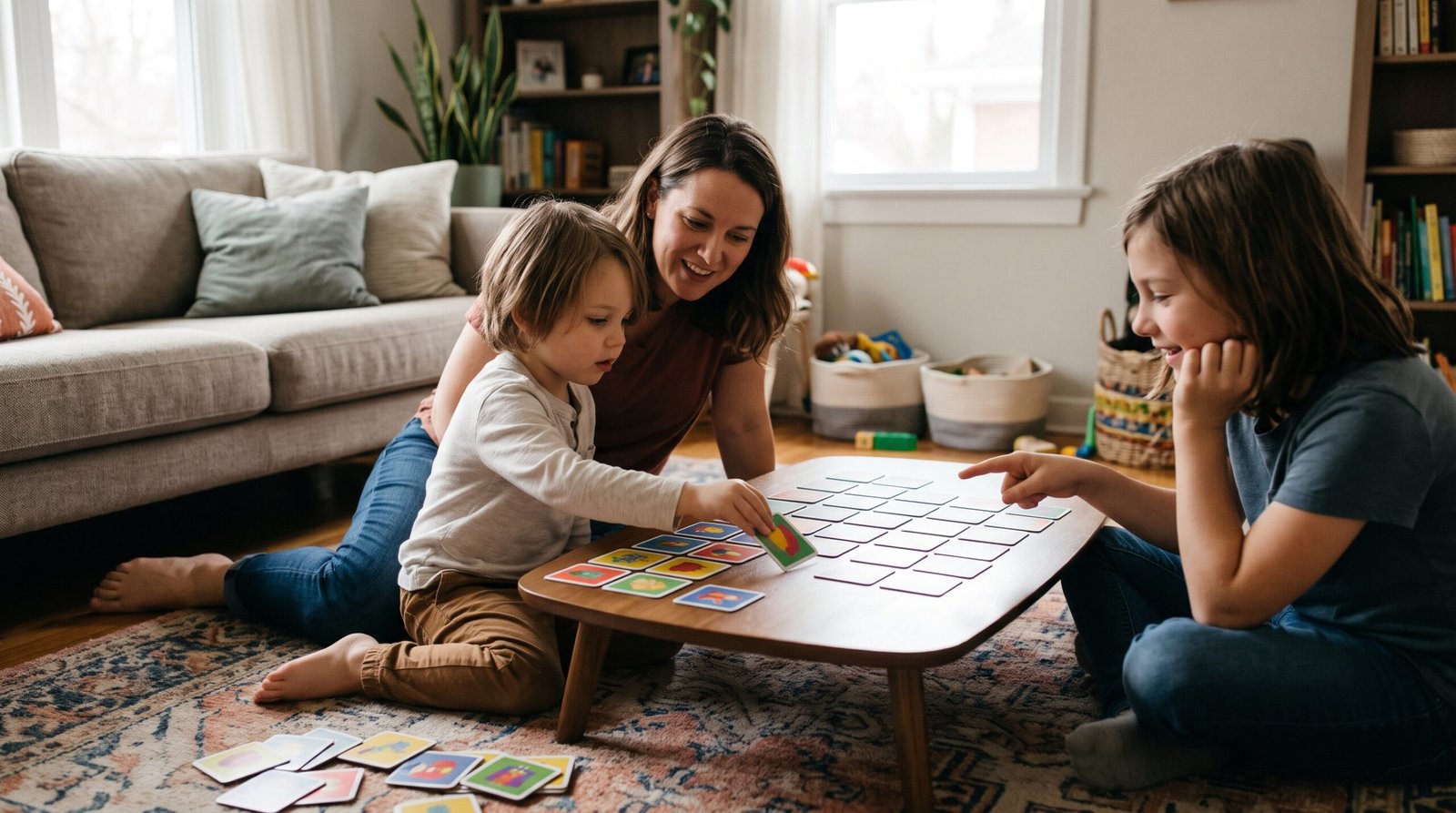
Memory games help children practice remembering information, recognizing patterns, and maintaining attention.
A simple matching game involves placing picture cards face down and asking children to find matching pairs.
You can use cards showing animals, fruits, shapes, numbers, or everyday objects.
To make the activity more challenging:
- Increase the number of cards gradually.
- Ask children to remember where specific pictures are located.
- Introduce different categories.
- Encourage them to explain how they remember certain matches.
These games make memory practice enjoyable for the whole family.
6. Singing Songs and Learning Rhymes
Music and rhymes can support language development, listening, rhythm recognition, and memory.
Children often enjoy repeating songs, learning new words, and participating in musical activities.
Try singing nursery rhymes, playing simple musical instruments, or creating songs about everyday routines.
Fun musical activities include:
- Singing alphabet songs.
- Learning counting rhymes.
- Clapping along with music.
- Playing simple drums.
- Making up original songs.
- Dancing to different rhythms.
Music provides an enjoyable opportunity for children to explore sounds, language, and movement.
7. Playing Outdoor Games
Outdoor play supports physical health and gives children opportunities to explore their environment.
Running, jumping, cycling, and playing ball games help children develop coordination, balance, and body awareness.
Outdoor activities also encourage social interaction and creative thinking.
Some enjoyable outdoor games include:
- Hide-and-seek.
- Catch and throw.
- Hopscotch.
- Obstacle courses.
- Bicycle riding.
- Nature exploration.
Encourage children to spend time outdoors regularly while following age-appropriate safety precautions.
8. Exploring Nature and Gardening
Nature exploration helps children develop curiosity and understand the world around them.
Gardening is a particularly enjoyable activity because children can observe how plants grow and learn about water, soil, sunlight, and living things.
Nature-based learning ideas:
- Plant flowers or vegetables.
- Observe butterflies and birds.
- Collect and identify leaves.
- Explore different textures in nature.
- Watch seeds grow over time.
- Learn about weather and seasons.
Ask questions such as, “Why do you think plants need sunlight?” or “What might happen if we forget to water this plant?”
These conversations encourage observation and scientific thinking.
9. Playing Pretend and Imaginative Games
Pretend play allows children to explore different roles, create stories, and use their imagination.
They might pretend to be doctors, teachers, shopkeepers, chefs, or astronauts.
These experiences help children practice communication, creativity, emotional expression, and social understanding.
Ideas for imaginative play:
- Create a pretend grocery store.
- Set up a toy hospital.
- Play restaurant.
- Build a pretend classroom.
- Organize an imaginary space adventure.
- Create stories using dolls or toy animals.
Parents can participate, but children should also have opportunities to lead their own imaginative games.
10. Cooking Simple Recipes Together
Cooking can become an enjoyable learning experience for children.
Simple kitchen activities introduce basic mathematics, sequencing, following instructions, vocabulary, and problem-solving.
For example, children can count fruit pieces, measure ingredients with help, mix ingredients, and observe changes during food preparation.
Child-friendly cooking activities:
- Making fruit salad.
- Decorating sandwiches.
- Preparing simple snacks.
- Mixing pancake batter with supervision.
- Arranging colorful vegetables.
- Making homemade yogurt parfaits.
Always choose age-appropriate tasks and supervise children carefully around sharp objects, hot surfaces, and electrical appliances.
11. Playing With Shapes, Colors, and Numbers
Learning basic shapes, numbers, and colors through play can support early mathematical understanding and visual recognition.
Instead of relying only on worksheets, introduce everyday learning games.
For example:
- Ask children to identify objects of different colors.
- Count toys while putting them away.
- Sort objects by shape or size.
- Match numbers with quantities.
- Create patterns using colored blocks.
- Play simple counting games during walks.
These activities make early learning interactive and enjoyable.
12. Learning a New Language
Language learning introduces children to new vocabulary, sounds, expressions, and communication styles.
Parents can introduce another language through songs, picture books, everyday conversations, and simple games.
Easy language-learning activities:
- Learn five new words each day.
- Use picture flashcards.
- Sing songs in another language.
- Name household objects.
- Practice simple conversations.
- Read bilingual storybooks.
Keep the experience enjoyable and avoid putting pressure on children to memorize everything immediately.
13. Playing Board Games and Strategy Games
Board games offer opportunities to practice decision-making, turn-taking, logical thinking, and following instructions.
Depending on the game, children may also learn counting, planning, patience, and cooperation.
Some family-friendly options include:
- Snakes and Ladders.
- Ludo.
- Dominoes.
- Simple chess.
- Connect Four.
- Age-appropriate strategy games.
Choose games based on your child’s developmental level. Focus on enjoying the activity rather than always winning.
14. Dancing and Movement Activities
Movement activities combine physical exercise with listening, coordination, and memory.
Children can follow dance instructions, imitate movements, and create their own dance routines.
Try these activities:
- Freeze dance.
- Follow-the-leader.
- Musical statues.
- Simple dance routines.
- Animal movement games.
- Clapping and jumping patterns.
These games can make physical activity enjoyable while giving children opportunities to practice coordination and attention.
15. Telling Stories and Creating Your Own Adventures
Storytelling is a wonderful way to develop imagination, language, creativity, and communication.
Instead of always reading prepared stories, encourage children to create their own characters and adventures.
Start with a simple question such as, “What would happen if a little rabbit discovered a magical forest?”
Ask your child to describe the characters, setting, problems, and ending.
You can also create a family storytelling game in which each person adds one sentence to continue the story.
This activity encourages creative expression and helps children organize their thoughts.
How Much Time Should Children Spend on Brain Development Activities?
There is no single schedule that works for every child. The right amount of play and learning depends on age, interests, energy levels, and individual needs.
Parents should focus on providing a healthy balance of play, physical activity, sleep, social interaction, and learning.
Here is a simple example of how to organize everyday activities:
| Activity | Suggested time |
|---|---|
| Reading together | 10–20 minutes |
| Puzzles and brain games | 10–15 minutes |
| Creative activities | 15–30 minutes |
| Outdoor play | Around 60 minutes or more of daily physical activity, as age and ability allow |
| Family interaction | Throughout the day |
These are flexible planning suggestions, not strict medical requirements. Children should also have plenty of time for free play without adult-directed tasks.
Tips for Parents to Make Learning More Enjoyable
Parents play an important role in creating positive learning experiences. The goal should be to make activities enjoyable rather than turning every moment into a lesson.
Here are some helpful suggestions:
- Choose activities according to your child’s age and interests.
- Encourage curiosity and questions.
- Avoid comparing your child with other children.
- Give children opportunities to explore independently.
- Celebrate effort and creativity.
- Keep learning sessions flexible and enjoyable.
- Participate in activities whenever possible.
- Provide a safe environment for exploration.
- Allow children to make mistakes.
- Balance structured activities with free play.
Remember that children learn at different speeds. Give them enough time and encouragement to explore new skills.
Conclusion
Supporting your child’s brain development does not require expensive educational programs or complicated learning methods. Everyday experiences can provide valuable opportunities for children to develop memory, creativity, language, concentration, and problem-solving skills.
These 15 Fun Activities offer simple ways to combine learning and entertainment at home, outdoors, and with family members.
From reading storybooks and solving puzzles to exploring nature, cooking, and playing imaginative games, each activity gives children opportunities to discover something new.
The most important thing is to make learning enjoyable, provide encouragement, and allow children to explore at their own pace. With patience, positive interaction, and regular play opportunities, parents can support healthy development and help their children build skills that benefit them throughout life.