People use the words “health” and “wellness” as if they mean the same thing. You’ll hear someone say “I’m focusing on my health” in one sentence and “I’m focusing on my wellness” in the next, and most listeners won’t blink. But if you’ve ever stopped to ask what is the difference between health and wellness, you’ve probably noticed that the two words point to two different — though closely related — ideas. Understanding that difference isn’t just a semantic exercise. It changes how you set goals, how you measure progress, and how you think about what it actually means to live a good life in a body that works.
This article breaks down what is the difference between health and wellness in detail: where each concept comes from, how experts define them, why the distinction matters in daily life, and how you can use both ideas together to build a more complete picture of your own wellbeing.
Why This Question Comes Up So Often
Walk into any gym, pharmacy, or doctor’s office and you’ll see both words plastered on walls, brochures, and apps. “Health services.” “Wellness center.” “Health insurance.” “Wellness retreat.” The marketing world has blurred the line between the two so thoroughly that most people never pause to ask what is the difference between health and wellness, because the words seem interchangeable in everyday use.
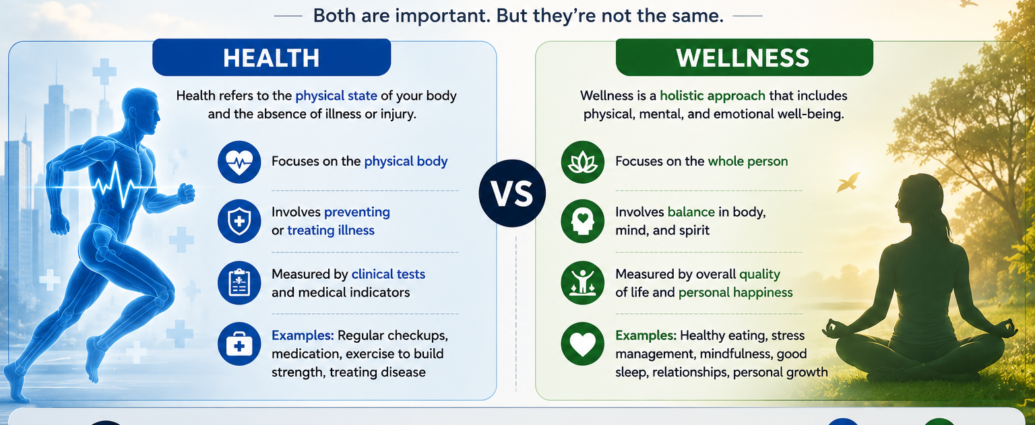
But the two terms actually describe different things. Health is generally understood as a state — a measurable, often medical, condition of your body and mind at a given point in time. Wellness is generally understood as a process — an ongoing, active pursuit of choices and habits that move you toward a fuller, more balanced life. One is a snapshot. The other is a journey.
Defining Health

The Traditional View
For most of medical history, “health” was defined narrowly: the absence of disease or injury. If your blood tests came back normal, if you had no diagnosed illness, and if your body was functioning without obvious impairment, you were considered healthy. This is sometimes called the biomedical model of health, and it still underpins a huge amount of how healthcare systems operate today — diagnosis, treatment, and the elimination of pathology.
The Modern, Broader View
In 1948, the World Health Organization redefined health as more than simply not being sick. Their definition describes health as a state of complete physical, mental, and social wellbeing, not merely the absence of disease. This shift was significant because it acknowledged that a person could be free of diagnosable illness and still not be thriving — someone might have no measurable disease but still struggle with chronic stress, poor sleep, isolation, or a body that functions but doesn’t feel vital.
Even with this broader WHO definition, health still tends to be discussed in terms of states that can be assessed: blood pressure readings, cholesterol levels, BMI, mental health diagnoses, fitness test results, and so on. Health is something a doctor can, in large part, measure and document.
Health Is Largely Objective
One of the most important things to understand when exploring what is the difference between health and wellness is that health leans objective. It’s tied to biological markers, clinical assessments, and diagnostic criteria. Two people can be handed the same medical chart and largely agree on whether someone is “healthy” by conventional standards, because the criteria — blood sugar levels, heart rate, the presence or absence of disease — are external and testable.
Defining Wellness
A Different Starting Point
Wellness starts from a different question. Instead of asking “is anything wrong with this body?” wellness asks “is this person actively thriving, and are they making choices that support a full, balanced life?” Wellness encompasses not just physical condition but emotional balance, mental clarity, social connection, sense of purpose, financial stability, and even spiritual fulfillment for those who value that dimension.
Wellness is commonly broken into multiple interconnected dimensions, which typically include:
- Physical wellness — nutrition, exercise, sleep, and preventive care
- Emotional wellness — the ability to understand, process, and manage feelings
- Mental/intellectual wellness — curiosity, learning, and cognitive engagement
- Social wellness — relationships, community, and a sense of belonging
- Occupational/financial wellness — satisfaction and security in work and finances
- Spiritual wellness — a sense of meaning, purpose, or connection to something larger
- Environmental wellness — the quality of the spaces you live and work in
Wellness Is Largely Subjective and Active
Wellness is something you do, not just something you have. It’s an active, ongoing pursuit rather than a fixed condition. This is a key part of the answer to what is the difference between health and wellness: wellness involves intentional choices — the decision to go for a walk, call a friend, set a boundary at work, meditate, or pursue a hobby that brings meaning. It’s less about a single measurable number and more about a subjective, lived sense of thriving.
Two people with identical bloodwork can have very different levels of wellness. One might feel energized, connected, purposeful, and at peace. The other might feel exhausted, isolated, anxious, and adrift — despite having a clean bill of health on paper. That gap is exactly why the distinction matters.
Health vs. Wellness: A Side-by-Side Comparison
| Aspect | Health | Wellness |
|---|---|---|
| Nature | A state or condition | An active process or pursuit |
| Focus | Presence or absence of disease/dysfunction | Overall balance and quality of life |
| Measurement | Largely objective (labs, diagnoses, vitals) | Largely subjective (self-reported, holistic) |
| Scope | Physical and, increasingly, mental condition | Physical, emotional, social, occupational, spiritual, environmental |
| Who assesses it | Often a clinician or medical test | Primarily the individual, sometimes with coaching support |
| Time orientation | Point-in-time snapshot | Ongoing, lifelong journey |
| Example | “My cholesterol is within normal range.” | “I feel fulfilled, connected, and balanced in my life.” |
Why the Distinction Actually Matters
1. You Can Be Healthy but Not Well
Someone can pass every physical exam with flying colors and still feel burned out, lonely, or directionless. Clinical health doesn’t guarantee a rich, satisfying life. This is one of the clearest illustrations of what is the difference between health and wellness — the absence of disease doesn’t automatically produce a sense of thriving.
2. You Can Be Well While Managing a Health Condition
Conversely, someone living with a chronic illness or disability can still experience high levels of wellness. They might manage their condition skillfully, maintain strong relationships, find purpose in their work, and approach life with resilience and gratitude. Wellness doesn’t require a “perfect” body; it requires an active, intentional relationship with the life you actually have.
3. Different Goals Require Different Strategies
If your goal is purely clinical health, your strategy might involve regular checkups, medication adherence, lab monitoring, and following a doctor’s treatment plan. If your goal is wellness, your strategy expands to include stress management, relationship-building, purpose-finding, financial planning, and lifestyle design. Knowing the difference helps you choose the right tools for the right goal instead of assuming a gym membership alone will fix a sense of emptiness, or that meditation alone will fix high blood pressure.
4. It Reframes How We Talk About “Success”
Public health campaigns historically measured success by disease rates, mortality statistics, and clinical outcomes. Wellness-oriented thinking has pushed institutions — from employers to insurers to governments — to also measure things like life satisfaction, stress levels, and social connectedness. This broader lens has reshaped everything from workplace benefits to community planning.
How Health and Wellness Work Together
It’s tempting to treat health and wellness as competing frameworks, but they’re better understood as complementary layers of the same picture. Health provides the biological foundation — a functioning body and mind free of significant disease — while wellness is what you build on top of that foundation through daily choices, relationships, and mindset.
Think of health as the structural integrity of a house: the foundation, the wiring, the plumbing. Wellness is everything that makes the house a home: how it’s decorated, how it’s used, whether it feels warm and alive. A house can have flawless plumbing and still feel empty. A house with a few structural quirks can still feel deeply lived-in and loved. Ideally, you want both — solid structure and a life that feels full inside it.
This is ultimately the most useful way to answer what is the difference between health and wellness: health is the biological baseline you maintain and protect, while wellness is the intentional, ongoing effort to live fully within — and sometimes despite — that baseline.
Practical Ways to Support Both
Supporting Your Health
- Schedule regular checkups and screenings appropriate for your age and risk factors
- Follow evidence-based nutrition and exercise guidelines
- Get consistent, adequate sleep
- Manage existing conditions with your healthcare provider
- Avoid known risk behaviors (smoking, excessive alcohol, etc.)
Supporting Your Wellness
- Build and maintain meaningful relationships
- Pursue work or activities that feel purposeful
- Practice stress-reduction techniques like journaling, mindfulness, or time in nature
- Set boundaries that protect your emotional energy
- Reflect regularly on whether your daily life aligns with your values
- Create physical and digital environments that support calm and focus
Common Misconceptions
“Wellness is just a marketing term.” While the wellness industry has certainly commercialized the concept, the underlying idea — that a full life requires more than the absence of disease — is grounded in decades of psychological and public health research, not just branding.
“If I’m healthy, I don’t need to worry about wellness.” Clinical health is necessary but not sufficient for a fulfilling life. Many people with excellent lab results still report low life satisfaction, chronic stress, or a persistent sense that something is missing.
“Wellness is only about self-care and spa days.” Genuine wellness includes far more than relaxation — it includes hard, sometimes uncomfortable work like repairing relationships, confronting financial stress, or making career changes that align with deeper values.
Final Thoughts
So, what is the difference between health and wellness in the simplest possible terms? Health is a state — largely physical, often measurable, and typically assessed by clinical standards. Wellness is a process — a holistic, ongoing, and deeply personal pursuit of balance across every dimension of life, including physical, emotional, social, occupational, and spiritual wellbeing.
Neither concept replaces the other. Health without wellness can leave you technically fine but quietly unfulfilled. Wellness without attention to health can leave you feeling purposeful but physically at risk. The most complete approach treats them as two hands on the same body — one steadying the physical foundation, the other shaping a life worth living on top of it. Once you understand what is the difference between health and wellness, you can stop chasing a single number or a single feeling, and instead build a life that is both medically sound and genuinely well-lived.